by Narmina Balabeyli
Updated:
5 min
Have you ever typed a query into Google… and it somehow "got" you?
I remember my first interaction with Google back in 2006. If I searched a word with a typo, it would show completely different results. The same thing happened when I searched the singular vs. plural. So I would try different variations to see different results (just for fun).
But modern search engines works differently. They try to understand the meaning, context, and intent of your search. They look at what you're really asking, what you likely want to achieve based on the words you chose, and what kind of search results would satisfy your search.
That's semantic search and semantic relevance in the search engine results page.
What is semantic relevance?
Semantic relevance is how well your content matches the meaning and intent behind a search query. In simple words, semantic relevance means: does this page answer what the searcher actually means, not just the exact words they typed? The results you see on the SERP are the pages that search engines consider the most semantically relevant to the search query.
And, semantic search is a data searching technique where a search engine tries to understand the meaning and intent behind your query (not just matching exact keywords).
You may have noticed that, if you refresh the page or search the same query twice, the SERP may show different pages, assuming the previous pages did not satisfy you.
Let's understand semantic relevance with a couple of examples.
Imagine you search for "apple charger." With semantic search technique, Google understands that “Apple” is not a fruit here, and that you’re not looking for a fruit charger, but an iPhone charger. Semantic search understands the intent behind your search query and shows you products to buy. In this example, the "apple charger" query has transactional intent.
Another example is user/situational context of semantic search. When you search for “best place to eat near me,” Google uses your location to show local results. For queries like “hair salon” or “best place to..”, Google may treat them as local-intent searches and rank results using signals like relevance, distance, and prominence. Depending on your browser settings, Google may also adjust and filter the results using context such as your location and sometimes your past search activity.
Here, I searched for "an italian meal that has pasta with heavy cream". Google knew exactly what I was looking for even though I did not use "Fettuccine" or the correct grammar in my search query. Below, the answer to the searched query is semantic relevance that best answer the search query:

How does semantic search work?
To create content that is more likely to rank well for many queries (the more keywords your page ranks for, the better), we should understand how semantic search works.
After we know how semantic search works, we'll understand how search engines decide that “Does this page answer what the searcher actually means?”
To answer that, search engines go through certain steps and assess semantic relevance in a few layers.
Google describes the semantic search process like this:
Query analysis
Knowledge graph integration
Content analysis
Results return and retrieval
1. First, search engine analyzes the query
First, the search engine analyzes the query. It identifies the keywords, phrases, and entities in the user’s search and examines how they relate to each other to understand the query intent.
In this step, NLP (Natural Language Processing) helps interpret relationships between words. This helps the engine understand queries more like a person would. Google has explained, for example, that BERT is used to better understand queries for ranking and snippets.
2. Secondly, search engines integrates knowledge graphs
Next, search engines tries to understand the context of the search query. For this, it uses the knowledge graphs and databases that contain information about entities and their relationships.
This is known as “Entity recognition and relationships”. In semantic search, this means the system treats words as real-world things (entities) and figures out how those things are related, so it can match by meaning, not just exact words.
For example:
Recognize “Apple”
Link it to a specific ID in a knowledge graph
Reason with structured facts: Apple CEO Tim Cook, Apple headquarters Cupertino, etc.
3. Next, search engines analyzes content
In this step, search engines analyze the content of indexed web pages to determine their semantic relevance to the search query. This analysis considers factors such as the overall topic quality and coverage, sentiment, and entities mentioned within the content.
Search engines look for strong ON-page SEO signals that the page is actually about the topic. For this, search engines evaluate topic coverage to decide “does it answer the full need?”. A page can mention the topic and still be unhelpful.
What do we mean by saying "helpful content"? It's when the content gives a complete, satisfying answer for the intent (including key sub-questions). Google explicitly emphasizes creating helpful, reliable, people-first content rather than content made to “manipulate search rankings.”
4. Lastly, search engines return and retrieve the results
After the analysis of the query and the content, the search engine returns web pages according to their relevance and semantic similarity to the search query. It then retrieves and displays the most relevant results to the user. In other words, the SERP is sorted by relevance: when you search, the results are ranked by how well each page matches the meaning and intent of your query.
Search engines assess the semantic matching/similarity with vector search and embeddings. It is a technique to compare similar objects using embeddings and match concepts based on meanings. Queries and web pages are represented as embeddings (vectors), and their similarity helps the system find conceptually related content even when the wording is different. Google refers to this type of concept-level matching as neural matching.
For many queries, relevance depends on who is searching and where/when. For ranking results, Google may use signals like location, past search history, and search settings to decide what’s most relevant “in the moment.”
What do you gain by making your content semantically relevant?
Well.. the list can go on and on.
Semantic search is how Google decides whether your page matches what people mean. Once you understand the semantic search, how semantic relevance work, and create content accordingly, you get the following benefits:
You rank for more queries. If your page covers the topic and intent well, it can show up for many variations, synonyms, and long-tail searches. For long tail, conversation-like queries, your page can be cited in AI chatbots and AI overviews.
You win more “high-intent” traffic. When your content matches intent, you attract visitors who are actually looking for that solution, not random readers.
You stay more stable through updates. Keyword-stuffed pages are easier to demote. Intent-first, helpful pages tend to hold rankings better because they satisfy needs.
You reduce “wrong traffic” and bounce. If your page makes its topic and purpose clear (entities, context, supporting subtopics), Google is less likely to send people who wanted something else.
You become eligible for more SERP opportunities. Clear structure, good answers, and proper schema can help with rich results and features (not guaranteed, but possible).
How to improve your content's semantic relevance?
1. Start with intent: make the page genuinely “needs-met”
Create content with a purpose: help readers learn something, compare options, buy a product, or troubleshoot a problem, etc. Figure out which one your page is meant to serve. Then, write to satisfy what the searcher is trying to accomplish.
Regardless of the intent you want to match (informational or commercial), your aim should be creating helpful, reliable, people-first content over content that is created primarily to rank. Google prioritizes it the most.
2. Use natural language and the words people actually use
Include the core terms of the topic and naturally use related wording where it fits in your web content. Use related words, entities, phrases throughout the main content. For example, if your topic is yoga, you can use the related entities like "Patanjali", "Ashtanga" or words like "meditation".
Also, practice on-page SEO to make it clear what your page is about. Ensure each page has a descriptive title and clear on-page structure. For image-heavy category pages, Google’s developer guidance recommends providing textual context.
3. Build “topic clusters” as a clear site structure (pillar + supporting pages)
Topic clusters isn’t a guaranteed “ranking tactic,” but it’s a practical way to create strong information architecture in your website. Topic clustering is when you group related pages around one pillar page and link them with internal links.
Google says its systems analyze your site’s link structure to understand and surface shortcuts (like sitelinks), and it highlights link architecture as important for discovery and navigation.
4. Practice internal linking with descriptive anchor text
Google discovers pages through other web pages (that are already crawled and indexed), both on your website and on others. Make sure search engines can reach all the pages in your website via crawlable links.
Also, use anchor text that explains what the linked page is about (instead of “click here” or plain URL). You’ll see this idea reflected in Google patents that describe incorporating anchor text into ranking/scoring:
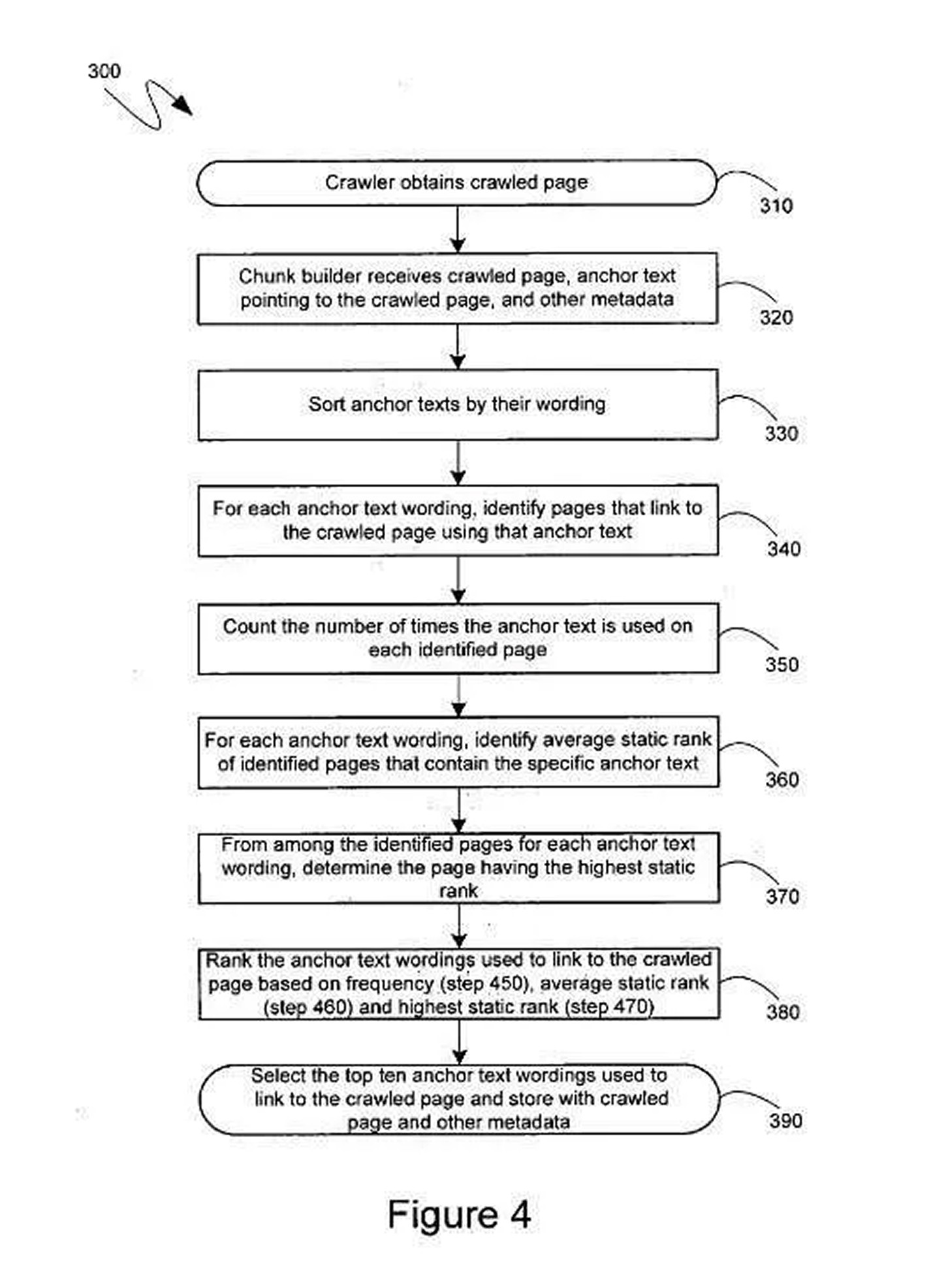
This is how linking and semantic relevance work together: internal links between related pages, with descriptive anchors, tell search engines how your pages connect to the topic and to each other.
5. Implement structured data where it truly matches your content
Structured data can help Google understand what's on the page and make you eligible for certain rich results. But Google states that structured data only enables features and does not guarantee they will show, and it isn't a shortcut to "prove" relevance.
It's also worth knowing that rich results eligibility changes over time. Google removed HowTo rich results in 2023 and fully retired FAQ rich results in May 2026, so those markup types no longer produce any visual feature in Search.
The lesson is to use structured data that genuinely describes your content, such as Product, Recipe, Article, or Event types that still generate rich results, rather than adding markup purely to chase a SERP feature that may be narrowed or dropped later.
6. Answer common follow-up questions (don’t “optimize for PAA” specifically)
When someone searches for something, they usually have more questions about the same topic once they see the results. Google shows these in a SERP feature named "People Also Ask" (PAA), the expandable list of related questions and answers.
It's smart to include concise answers to your content for the questions users commonly ask, because it may improve your page's usefulness and intent coverage, which is the real goal.